
Investing in sports has long been treated like a trophy asset class for billionaires. Now, new rules are making it possible for a broader set of investors to participate.
In September 2026, Allocate hosted its second annual Converge conference, bringing together more than 150 investment and wealth advisory leaders in Austin. The event included a panel discussion on sports as an asset class, featuring Ian Charles, CEO and co-founder of Arctos, and Mark Affolter, Head of Sports, Media & Entertainment at Ares. This was one of the conference’s most anticipated and well-received sessions, a sign of how quickly sports investing is going mainstream in the wealth channel.
Below are our takeaways from the discussion. The Big Four leagues are now open to institutional capital, and exposure is increasingly reaching eligible investors through their wealth advisors. Capturing the opportunity, though, depends on choosing the right partners.
Why Now: The Big Four Leagues Are Opening to Capital
For most of their history, the “Big Four” US sports leagues (the NFL, MLB, NBA, and NHL) required owners to be deep-pocketed individuals or families. As franchise values have climbed, the pool of eligible buyers has shrunk. There simply aren’t enough people who can afford a multibillion-dollar check.
To keep deals moving, the leagues have loosened their ownership rules. In 2019, MLB became the first of the Big Four to allow private equity investors to hold minority interests in franchises. The NHL and NBA followed with similar structures in 2021. The NFL held out until 2024, when it opened investment to a small set of approved firms.
The firms buying minority stakes are increasingly packaging them into dedicated funds, typically offered to eligible investors through their advisors. For example, Ares launched a sports strategy for individual investors in 2025 at the request of financial advisors. By mid-2026, the fund had already grown to nearly $1 billion in assets.
Premium Sports Has Provided Differentiated Returns
Investors have sometimes dismissed sports teams as status symbols for the hyperwealthy. The numbers say otherwise.
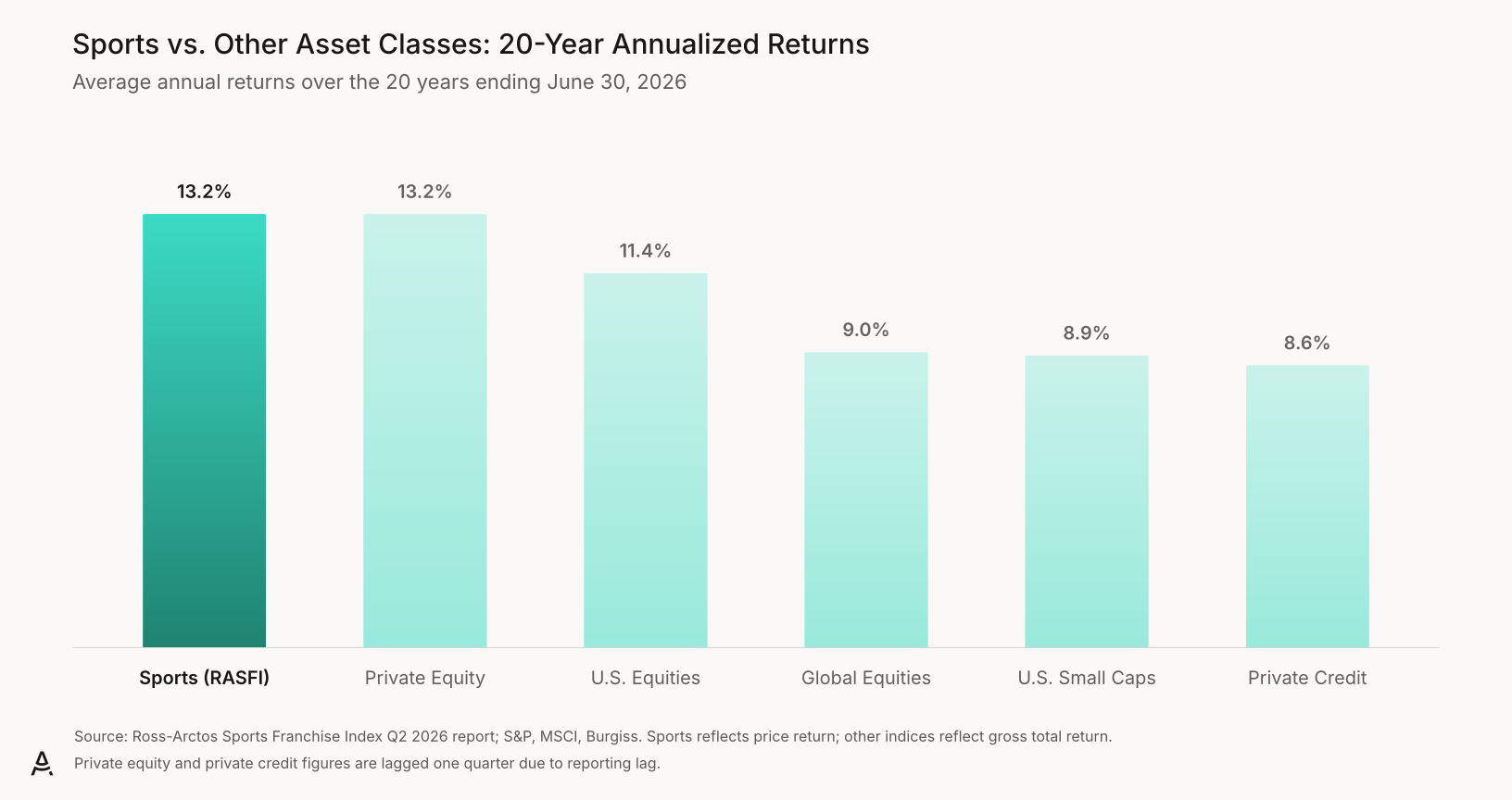
Over the past 20 years, sports franchises in the Big Four leagues have appreciated at an average annual rate of 13.2%, according to the Ross-Arctos Sports Franchise Index. In comparison, US equities have gained 11.4% annually over the same period. While fund-level returns differ, and past performance is no guarantee of future results, these figures show that franchises have held their own as investments.
Several features of the franchise business model make this track record more than a lucky run:
- Non-replicability. Sports teams have some of the most powerful brand moats in existence, giving them enormous scarcity value. You can’t make another Dallas Cowboys.
- Content premium. AI is making content cheaper and more abundant, but live sports can’t be generated. That means broadcasters and streamers are willing to pay a premium for sports media rights. Between 2015 and 2025, spending on US sports media rights grew by 122%, five times faster than the broader TV market.
- Escalator clauses. Media and sponsorship deals are often long-dated agreements with built-in annual increases. That typically results in predictable revenue growth above inflation and unusual visibility into future cash flows.
It’s worth noting what’s not on this list. On-field performance matters, but revenue sharing means that franchise values tend to track league-wide economics. League rules also cap debt, so financial engineering plays little role in franchise appreciation.
Together, these dynamics mean that franchise values are generally insulated from macro drivers like interest rates and corporate earnings. In fact, Ares has reported near-zero correlation between sports investing and global equities from 2007 to 2024. And with tech becoming a growing share of equity indexes, an asset class that sits outside the AI trade could be increasingly appealing.
Not All Sports Exposure Is Created Equal
Sports isn’t a monolith. Before allocating, advisors should understand what a fund holds and how its manager invests.
Owning a stake in a Big Four franchise is a different proposition from backing a team in an emerging league. And because leagues determine which firms are allowed to participate, only a handful of managers can offer meaningful exposure. Strategies differ, too, with some managers lending against media deals or stadium real estate rather than taking equity stakes.
Equity stakes come with their own trade-offs. They’re typically minority positions, with limited say in how a team is run. Leagues must approve ownership transfers, so liquidity can be thin and exits can take years. Because only a few franchises change hands each year, valuations rest on a small number of transactions.
Even so, for advisors seeking diversification, sports can work as a satellite position within a broader portfolio, and it’s one many clients enjoy owning. Manager selection still makes all the difference.