
Over the last several years, the wealth channel has changed how it approaches private markets. The question facing advisory firms is no longer whether to provide clients with private market exposure, but how that exposure should be delivered.
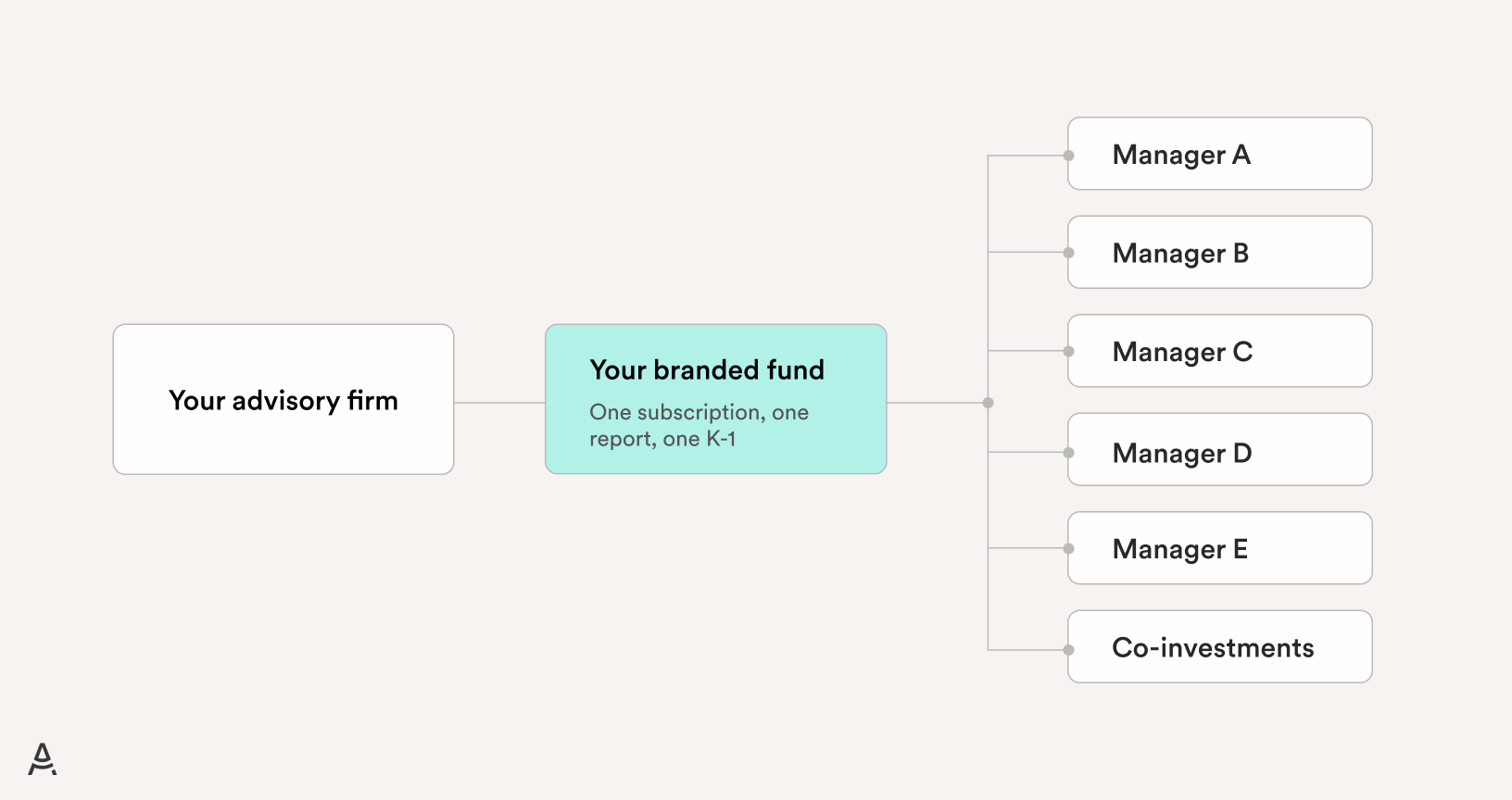
For most firms, delivery has meant selecting third-party funds one at a time. A growing number of advisory firms are now taking a different path and launching proprietary vehicles of their own: a single fund, built around the firm's client base, that holds a curated mix of managers, co-investments, and strategies.
Demand explains part of the shift. U.S. advisors now hold roughly $2.2 trillion in less-than-fully-liquid private capital, and Cerulli expects that figure to double over the next five years. 1 In a recent survey by a major alternatives platform, nearly nine in ten advisors said they plan to maintain or increase their alternatives allocations this year. 2 Bain estimates that individual investors globally could deploy as much as $14 trillion of new capital into private markets over the coming decade.
But demand alone does not explain why firms are choosing to build rather than buy. If the objective were simply more exposure, the market offers no shortage of funds to buy.
The reasons are structural, and they fall into three categories: control, simplicity, and access.
- Built for a specific client base rather than the broad market. A third-party fund is designed for every firm's clients. A proprietary fund is designed for one firm's clients. The advisor sets the return objective, liquidity profile, and tax posture to match the households it actually serves, rather than adapting those households to a product built for someone else.
- Diversified by design. Rather than asking each client to commit to five or six separate funds across venture, buyout, credit, and real assets, a single vehicle can hold all of them, across multiple managers, with position sizing determined by the firm. Diversification becomes a portfolio construction decision rather than a series of one-off allocations that may or may not aggregate into a coherent whole.
- One process to learn, for the firm and for its clients. Every new fund brings its own subscription documents, new client and advisor education, and reporting requirements. Advisors running deal after deal can risk client fatigue while facing the natural barriers of product education.
- Operationally simpler. Private markets have historically been operationally burdensome in the wealth channel. Consolidating into one structure collapses much of that burden: one set of offering documents, one investor onboarding flow, one reporting stack.
- One K-1 and a predictable capital call schedule. This is often the benefit clients notice first. Instead of separate K-1s from each underlying fund, frequently arriving at different times, investors receive one. Instead of a dozen unpredictable capital calls a year, the fund calls capital on a schedule the firm designs.
- Discretionary capital earns better access. This is the factor that matters most for long-term outcomes. Top-tier managers allocate scarce capacity to LPs who can commit with certainty. A firm that arrives with a discretionary pool and a defined check size is a fundamentally different counterparty from a firm that must circulate a deck to two hundred households and hope enough of them subscribe. Certainty of capital translates into access, and access translates into portfolio quality.
None of this comes without obligation. Kitces and others have written about the fiduciary considerations: proprietary products invite scrutiny, and fee layering must be structured thoughtfully and disclosed clearly. Operating a fund also means taking on formation, administration, valuation, tax reporting, and investor servicing, none of which is the reason clients engage their advisor in the first place.
That is a reason why the firms doing this strategy are not always building a fund business from scratch. They retain what is theirs, the client relationship and the investment strategy, and partner for everything else.
How do we help?
Allocate's white-label capability allows an advisory firm to launch a fund under its own brand while Allocate handles the functions that fall outside the firm's core business. The simplest way to describe it is a fund in a box: technology, investment expertise, and administration delivered together, through one partner, rather than assembled piecemeal from a modeling consultant, a fund administrator, a placement resource, and a marketing agency.
Allocate models the portfolio alongside the firm: asset class mix, manager selection, pacing, and cash flow projections against the firm's actual client base. Allocate runs administration end to end through its regulated infrastructure, including formation, capital call line set-up and management, subscription processing, capital calls, audit coordination, tax reporting, and investor financial reporting. Where useful, Allocate augments the firm's sourcing with access to managers and co-investments drawn from a network built over decades.
Launching a fund is only half the work; clients also have to understand it. Allocate supports the firm on that front as well, producing marketing materials, fund overviews, and client-facing education, and hosting webinars for the firm's advisors and clients so the fund is explained clearly and consistently. A dedicated white-glove team supports the firm and its clients throughout.
The firm owns the relationship and the strategy. Allocate provides the infrastructure and extends the firm's research and portfolio modeling capabilities through its team and technology. Advisors can leverage Allocate's investment opportunities with their white-label funds, use their own sourcing, or a combination of both.
Deciding to launch a fund is a strategic one, with several things to consider before launching. Please reach out to us to learn more about launching your own proprietary fund, and how we may be able to help.

IMPORTANT NOTES
1 - Source: The Cerulli Report — U.S. Private Markets 2026: Scaling Retail Access, July 2026.
2 - Source: iCapital's 2026 Global Advisor Survey, The Next Phase of Alternatives Growth, published August 11, 2026
Other Sources: Cerulli Associates, U.S. Private Markets 2026; Bain & Company, Global Private Equity Report; Kitces.com, Legal Requirements for RIAs to Launch a Private Fund.
This material is for informational purposes only and is not an offer to sell or a solicitation of an offer to buy any security. Private market investments involve substantial risk, including illiquidity and potential loss of principal.

.png)
.png)